

Article Archives
- February 2024
- January 2024
- September 2023
- August 2023
- July 2023
- May 2023
- April 2023
- March 2023
- February 2023
- November 2022
- October 2022
- September 2022
- August 2022
- July 2022
- June 2022
- May 2022
- February 2022
- January 2022
- November 2021
- October 2021
- September 2021
- August 2021
- July 2021
- June 2021
- May 2021
- April 2021
- March 2021
- February 2021
- January 2021
- December 2020
- November 2020
- October 2020
- September 2020
- August 2020
- July 2020
- June 2020
- May 2020
- April 2020
- March 2020
- February 2020
- January 2020
- December 2019
- November 2019
- October 2019
- September 2019
- August 2019
- July 2019
- June 2019
- May 2019
- April 2019
- March 2019
- February 2019
- January 2019
- December 2018
- November 2018
- October 2018
- September 2018
- August 2018
- July 2018
- June 2018
- May 2018
- April 2018
- March 2018
- February 2018
- January 2018
- December 2017
- November 2017
- October 2017
- September 2017
- August 2017
- July 2017
- June 2017
- April 2017
- February 2017
- January 2017
- December 2016
- November 2016
- October 2016
- September 2016
- August 2016
- July 2016
- June 2016
- January 2016
- December 2015
- November 2015
- October 2015
- September 2015
- August 2015
- July 2014
- June 2014
- May 2014
- April 2014
- March 2014
- September 2013
- April 2013
- March 2013
- October 2012
- All Current Articles
Article Categories
- Awards & Grants
- Bio Fuels
- Case Studies
- Clean Cities and Communities
- Clean Fuels Events - National/Regional
- Clean Fuels Events - Statewide
- Clean Fuels Funding
- Clean Fuels Infrastructure
- CNG
- Electric Vehicles
- Emissions & Fuel Economy
- Energy Efficient Mobility Systems (EEMS)
- EPA Advance Program
- Home Page
- Hydrogen Fuel Cell
- LCF Members
- LCF Press Releases
- Louisiana Department of Environmental Quality
- Louisiana News
- National News
- News
- Office of Critical Minerals and Energy Innovation
- Propane
- Tax Incentives
- Technical Workshops
- Webinar
- All Current Articles
Clean Fuel News
Lightning Systems Rolling out All-Electric Ford Transit System, Introducing Fuel Cell Version
Posted by Betsy Lillian
Via NGT News
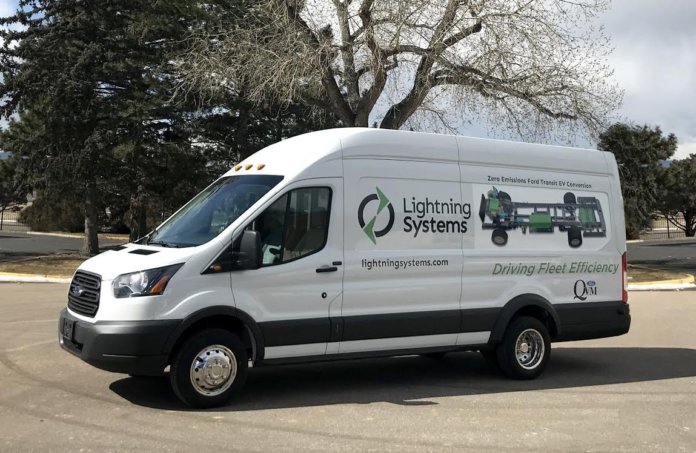 Loveland, Colo.-based Lightning Systems, a developer of efficiency and emissions improvement solutions for fleets, says it is on schedule for March deliveries of its new zero-emissions LightningElectric system for Ford Transit. Furthermore, the company has also developed a zero-emission hydrogen fuel cell range extender for the product.
The LightningElectric battery conversion package, available for Ford Transit as part of Ford Motor Co.’s eQVM program, was announced last September. As planned, the first customer deliveries will occur this month, says Lightning.
The product is on display in the Ford booth (#3239) at this week’s Work Truck Show in Indianapolis. Lightning will also host a series of ride and drive opportunities in California and New York in April; locations will be announced soon.
The new zero-emissions hydrogen fuel cell range extender for the LightningElectric Ford Transit has been developed in partnership with several industry partners and will extend the range of the LE 50 to over 200 miles, the company says. Beginning in Septmber, it will be available in California, where significant vouchers for fuel cell vehicles and infrastructure exist, Lightning notes.
Both the all-electric and the zero-emissions hydrogen fuel cell range extender are available for heavy-duty transits with a 10,360-pound gross vehicle weight rating. In addition, Ford’s vehicle warranty covers the base chassis for vehicles with the Lightning conversions. Installation and service are performed by Ford QVM upfitters and dealers around the world.
The all-electric Lightning product features a liquid-cooled lithium-ion battery that can be fast-charged in 30 minutes on DC fast charging and in six hours with Level 2 charging. Depending on battery option and drive cycle, LightningElectric has a payload capacity of up to 4,000 pounds, the company notes.
The LightningElectric fuel cell range extender uses hydrogen stored on-board in carbon fiber-wrapped pressure vessels equipped with sensors. The hydrogen is delivered to a fuel cell to charge the lithium-ion battery with up to 30 kW of power. The vehicle will have a range of over 200 miles and top speed of 75 miles per hour, says Lightning.
LightningAnalytics, a cloud-based analytics system that provides drive, route and predictive vehicle health scoring, is available as an option with every Lightning Systems vehicle. The analytics system provides fleets with real-time information to operate their fleet at peak efficiency, according to the company.
