

Article Archives
- February 2024
- January 2024
- September 2023
- August 2023
- July 2023
- May 2023
- April 2023
- March 2023
- February 2023
- November 2022
- October 2022
- September 2022
- August 2022
- July 2022
- June 2022
- May 2022
- February 2022
- January 2022
- November 2021
- October 2021
- September 2021
- August 2021
- July 2021
- June 2021
- May 2021
- April 2021
- March 2021
- February 2021
- January 2021
- December 2020
- November 2020
- October 2020
- September 2020
- August 2020
- July 2020
- June 2020
- May 2020
- April 2020
- March 2020
- February 2020
- January 2020
- December 2019
- November 2019
- October 2019
- September 2019
- August 2019
- July 2019
- June 2019
- May 2019
- April 2019
- March 2019
- February 2019
- January 2019
- December 2018
- November 2018
- October 2018
- September 2018
- August 2018
- July 2018
- June 2018
- May 2018
- April 2018
- March 2018
- February 2018
- January 2018
- December 2017
- November 2017
- October 2017
- September 2017
- August 2017
- July 2017
- June 2017
- April 2017
- February 2017
- January 2017
- December 2016
- November 2016
- October 2016
- September 2016
- August 2016
- July 2016
- June 2016
- January 2016
- December 2015
- November 2015
- October 2015
- September 2015
- August 2015
- July 2014
- June 2014
- May 2014
- April 2014
- March 2014
- September 2013
- April 2013
- March 2013
- October 2012
- All Current Articles
Article Categories
- Awards & Grants
- Bio Fuels
- Case Studies
- Clean Cities and Communities
- Clean Fuels Events - National/Regional
- Clean Fuels Events - Statewide
- Clean Fuels Funding
- Clean Fuels Infrastructure
- CNG
- Electric Vehicles
- Emissions & Fuel Economy
- Energy Efficient Mobility Systems (EEMS)
- EPA Advance Program
- Home Page
- Hydrogen Fuel Cell
- LCF Members
- LCF Press Releases
- Louisiana Department of Environmental Quality
- Louisiana News
- National News
- News
- Office of Critical Minerals and Energy Innovation
- Propane
- Tax Incentives
- Technical Workshops
- Webinar
- All Current Articles
Clean Fuel News
Fleet Management, Technology Deemed Essential for Cutting Freight Emissions
DUBAI, United Arab Emirates — Global efforts to improve freight efficiency and reduce carbon emissions will require a multifaceted approach that includes not only vehicle technology, but also better fleet management and capacity utilization, experts said.
Although fuel-saving technologies such as battery-electric vehicles and hydrogen fuel cells are beginning to show promise in commercial transportation, there are many other ways for shippers and carriers to take immediate action, said Sophie Punte, executive director of the Smart Freight Centre.
“While we of course need to invest in the long-term energy transition, we need to look right now at energy efficiency and optimizing loads,” she said here Nov. 16 at the Shell Rimula Ultimate Stopover event.
Fleet operations worldwide can boost efficiency and reduce emissions through improved fleet management, including driver training, better equipment specification and maintenance, and the use of information technology, Punte said.
The Smart Freight Centre, a global nonprofit based in the Netherlands, works with multinational shippers and transportation firms to reduce emissions in the transportation sector, in part through developing global guidelines and strategies.
Meanwhile, refinement of existing vehicle technologies also can chip away at fuel consumption and emissions.
“We are going to continue to see the push for improvements in fuel economy, and I think it’s going to be looking at everything on the vehicle, whether it’s aerodynamics, improvements in the drivetrain, and the engines,” said Dan Arcy, Shell’s global OEM technical manager and industry trade association liaison. “Customers want better fuel economy, and there are ways to get there.”
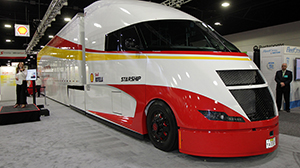
Project Starship truck by John Sommers II for Transport Topics
This year, Shell highlighted its vision for more efficient freight transportation with its Starship Initiative concept truck.
The vehicle, built through a partnership with AirFlow Truck Co., features a variety of fuel-saving technologies, including aerodynamic improvements, an active grille cooling system, roof-mounted solar panels, predictive cruise control, low-rolling-resistance tires and low-viscosity lubricants.
In May, Shell tested the truck’s efficiency on a cross-country run from San Diego to Jacksonville, Fla. Shell said the truck’s freight ton efficiency — the total amount of energy needed to move a load from one point to another — was 2.48 times greater than an average truck in North America due to improved miles per gallon and optimized payload.
Via TTNews.com
View original article...
