

Article Archives
- February 2024
- January 2024
- September 2023
- August 2023
- July 2023
- May 2023
- April 2023
- March 2023
- February 2023
- November 2022
- October 2022
- September 2022
- August 2022
- July 2022
- June 2022
- May 2022
- February 2022
- January 2022
- November 2021
- October 2021
- September 2021
- August 2021
- July 2021
- June 2021
- May 2021
- April 2021
- March 2021
- February 2021
- January 2021
- December 2020
- November 2020
- October 2020
- September 2020
- August 2020
- July 2020
- June 2020
- May 2020
- April 2020
- March 2020
- February 2020
- January 2020
- December 2019
- November 2019
- October 2019
- September 2019
- August 2019
- July 2019
- June 2019
- May 2019
- April 2019
- March 2019
- February 2019
- January 2019
- December 2018
- November 2018
- October 2018
- September 2018
- August 2018
- July 2018
- June 2018
- May 2018
- April 2018
- March 2018
- February 2018
- January 2018
- December 2017
- November 2017
- October 2017
- September 2017
- August 2017
- July 2017
- June 2017
- April 2017
- February 2017
- January 2017
- December 2016
- November 2016
- October 2016
- September 2016
- August 2016
- July 2016
- June 2016
- January 2016
- December 2015
- November 2015
- October 2015
- September 2015
- August 2015
- July 2014
- June 2014
- May 2014
- April 2014
- March 2014
- September 2013
- April 2013
- March 2013
- October 2012
- All Current Articles
Article Categories
- Awards & Grants
- Bio Fuels
- Case Studies
- Clean Cities and Communities
- Clean Fuels Events - National/Regional
- Clean Fuels Events - Statewide
- Clean Fuels Funding
- Clean Fuels Infrastructure
- CNG
- Electric Vehicles
- Emissions & Fuel Economy
- Energy Efficient Mobility Systems (EEMS)
- EPA Advance Program
- Home Page
- Hydrogen Fuel Cell
- LCF Members
- LCF Press Releases
- Louisiana Department of Environmental Quality
- Louisiana News
- National News
- News
- Office of Critical Minerals and Energy Innovation
- Propane
- Tax Incentives
- Technical Workshops
- Webinar
- All Current Articles
Clean Fuel News
NACFE Releases The Idle-Reduction Playbook
via NACFE.org | Published December 2025
The Idle-Reduction Playbook: Operational Strategies for Modern Trucking Fleets
Both the economic and environmental stakes of idling are high. At an average diesel price of $4 per gallon, a single long-haul truck might waste $4,000 to $6,000 worth of fuel each year if it idles overnight. For fleet operators, the challenge lies in finding practical ways to reduce idle time without compromising driver comfort, safety, or operational efficiency. any idle reduction strategy must provide an alternative heating, cooling, and auxiliary power source.
Over the years, various technologies and practices have been developed to meet this need. There are strategies for enhancing fuel efficiency and minimizing idling — both established and innovative technologies. Best practices and policy advancements provide considerable savings and environmental benefits for proactive fleets.
The trucking industry has made notable strides in reducing idling in recent years, fueled by escalating fuel prices, stricter emissions requirements, and sustainability objectives. Many fleets now employ automatic engine shut-off mechanisms, idle-limit timers, and APUs to minimize idling time. By installing APUs — either diesel or electric — fleets can keep the cab comfortable without running the main engine, allowing truck drivers to stay comfortable while cutting emissions and saving fuel.
Investing in idle-reduction technologies should ultimately be viewed through the lens of total cost of ownership. Here, we break down the costs, fuel savings, and payback periods of the significant technologies and techniques, providing estimates for both dollar savings and fuel consumption reduction.
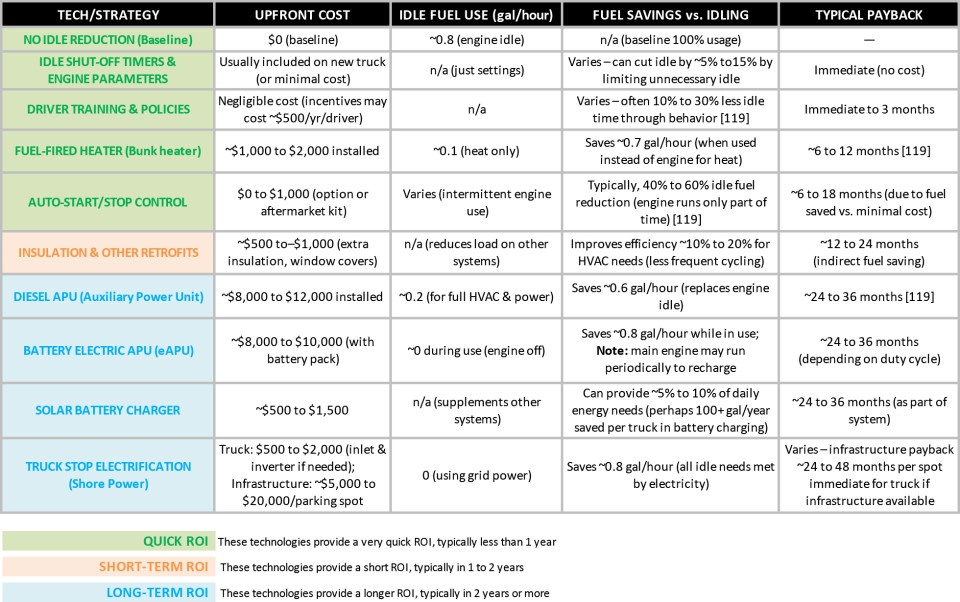
Baseline best practices include:
- Establishing an idle-reduction policy,
- Using engine parameters aggressively,
- Training and incentivizing drivers,
- Providing alternatives for driver comfort during downtime, and
- Monitoring and reporting idle percentages.
Advanced best practices include:
- Investing in appropriate idle-reduction equipment,
- Combining complementary idle-reduction technologies,
- Maintaining all idle-reduction devices,
- Monitoring idle-reduction efforts and adjust as needed.
DOWNLOAD THE EXECUTIVE SUMMARY
