
LCF News | January 2026 
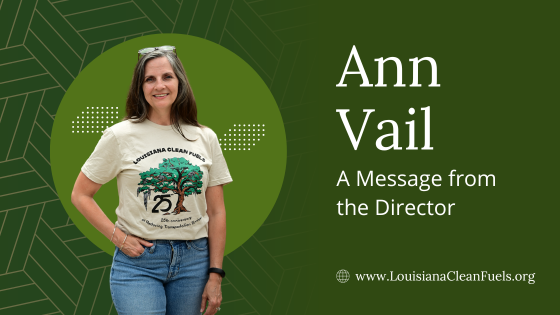
Letter from the Executive Director
Clean Fuel Leaders, Members, and Stakeholders:
As we settle into the new year, I’m grateful for the momentum we’re brining into 2026—and for the many members and stakeholders who continue to show up, contribute data, share expertise, and move clean transportation forward alongside us. January always feels like a reset and a recommitment, and this issue reflects exactly that spirit.
We’re excited to welcome new and returning members who have already renewed for 2026. Your continued support allows Louisiana Clean Fuels to stay focused on what we do best: connecting people to practical solutions, providing trusted technical assistance, and creating opportunities to learn from one another. Whether you’ve been with us for years or are just joining the coalition, we’re glad you’re here.
This month also marks the start of our annual rhythm—beginning with our 2026 Annual Stakeholder Meeting on January 26. This is a chance to reflect on what we accomplished together in 2025 and take a clear look ahead at the programs, technologies, and priorities shaping the year to come. I hope you’ll join us for the conversation and help set the direction for our work in the months ahead.
January also kicks off our Annual Fleet Activity Reporting, one of the most important ways you can support the coalition. From EV adoption and alternative fuels to efficiency strategies and infrastructure investments, your data helps tell the story of what’s happening on the ground in Louisiana—and strengthens our ability to advocate for funding, recognize leadership, and support future projects. Even small fleets and single vehicles make a difference.
Finally, I’m encouraged by the variety of activity highlighted in this issue—from national policy engagement and upcoming events in D.C., to hands-on training opportunities like our electric school bus webinar series, to new studies, resources, and data that continue to inform smart decision-making across our industry. There’s a lot happening, and it’s a good reminder that progress is built through collaboration.
Thank you for being part of this work. I look forward to connecting with many of you in the weeks ahead—and to another year of steady progress together.
Regards,
Ann Vail
Executive Director
Welcome New Members
Thank you to the following members who have either joined as 1st-time members or have renewed for 2026!
-
Delgado Community College (bronze)
-
Edison Chouest Offshore (silver)
-
Electric Vehicle Consulting LLC (silver)
- Port of New Orleans (silver)
-
Kenworth of Louisiana (platinum)
Clean Fuels Conference & Workshops
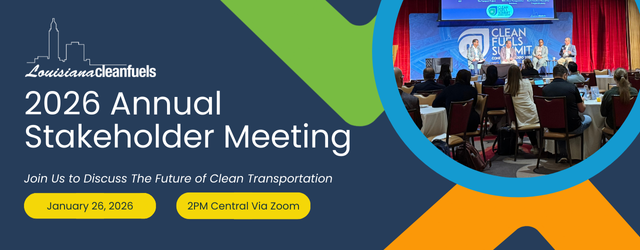
LCF 2026 Annual Stakeholder Meeting - Virtual
January 26, 2026 | 2PM - 3:30PM Central | Via Zoom
Join us via Zoom on Monday, January 26th as we focus our attention on our mission and the work at hand: to advance the nation’s environmental, economic, and energy security by supporting local actions to diversify transportation fuel options. On January 26th, as we do each year at our Annual Stakeholder Meeting, we will take a bold look forward to the new technologies and programs that will shape the future of transportation, and back at our accomplishments in 2025.

National Clean Fuels Events
Why You Should Join Us at EIS26 in D.C.
Congress is Listening. Join the Chorus.
Thanks to your collective advocacy, both chambers of Congress have signaled strong support for Clean Cities and Communities:
- Senate Energy & Water: $65M
- House Energy & Water Development & Related Agencies: $60M
This is a major win, but it’s not the finish line.
Now is the moment to amplify our message on Capitol Hill:
“The Clean Cities and Communities network is strengthening America’s domestic fuel security, lowering operating costs for U.S. fleets, and ensuring the reliability of our transportation system; all core components of President Trump’s vision for renewed American energy dominance and an all-of-the-above strategy.“
We need coalitions, industry partners, stakeholders, and allies - together in DC - to ensure these funds are protected, expanded, and deployed where they’re needed most.
Early Bird Registration Extended.
Deadline: Monday, January 19.
Don’t miss your chance to lock in the lowest rate for EIS26, taking place February 10-11, 2026 in Washington, DC at the MLK Jr. Memorial Library.
EIS26 is the premier national forum where clean transportation leaders, industry innovators, and federal policymakers come together to advance the future of clean fuels, advanced vehicles, and domestic energy independence. Join with LCF and come to D.C. to represent your industry and show solidarity for Clean Cities and Communities. Learn more and register with the link below:
Outreach Activities
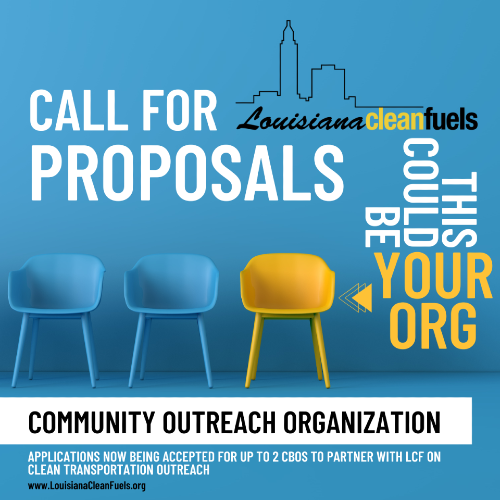
Call for Community-Based Organizations (CBOs)
Louisiana Clean Fuels is now accepting applications from community-based organizations to support our Great River Road Corridor Collaboration—a multi-state effort advancing clean transportation and alternative fuel infrastructure along the Mississippi River.
We will select up to two (2) CBOs in Louisiana:
💰 Award: $15,000 per organization (up to $30,000 total)
📅 Project term: ~March–December 2026
⏰ Application deadline: February 9, 2026
We’re looking for organizations with strong local connections in Louisiana along the Mississippi River that can support:
- Community outreach and listening sessions
- Participation in public events (e.g., farmers markets, community gatherings)
- Engagement with local stakeholders, businesses, and municipal partners
👉 RFP details (task list) can be found here: https://lnkd.in/esXcamTB
👉 RPF document: https://lnkd.in/eddEPAfS
👉 Apply here: (https://lnkd.in/ePzH-rMB ) - updated!
👉 Awards anticipated by March 1, 2026
Technical AFV Training
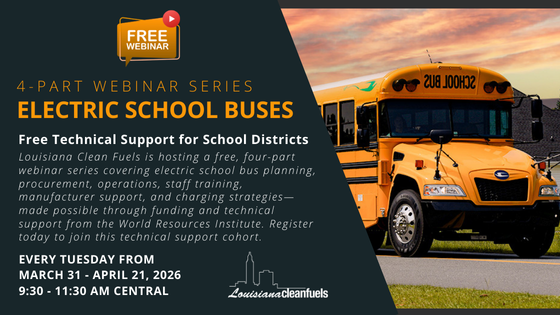
Free Support for Electric School Bus Districts: Four-Part Webinar Series
School districts across Louisiana—and nationwide—are navigating the opportunities and challenges of electric school buses (ESBs). With nearly 150 ESBs awarded to 13 Louisiana school districts through federal funding, many districts are at very different stages: some are still planning purchases, while others are actively operating and maintaining new electric fleets.
To help districts succeed, Louisiana Clean Fuels is hosting a free, four-part webinar series designed to provide practical guidance, peer learning, and access to trusted technical resources.
About the Project
Louisiana Clean Fuels has received funding and technical training support from the World Resources Institute (WRI) to assist school districts as they transition to electric school buses. This support is intended to help districts address real-world challenges—from procurement and staffing to maintenance and charging—at no cost to participating schools.
Some districts have secured funding but have not yet ordered buses. Others are already operating ESBs and managing the learning curve that comes with new technology. This webinar series creates a forum for districts to ask questions, learn from one another, and connect with professionals who can help solve specific, on-the-ground issues.
Who Should Attend
This series is open to all school districts—whether you already operate electric school buses, have received funding, or are simply exploring the technology. While the project is focused on supporting Louisiana districts, school districts from across the country are welcome to attend. Louisiana Clean Fuels is also happy to help connect non-Louisiana participants with regional resources where possible.
Webinar Schedule & Topics
Part 1 | March 31 | 9:30–11:30 a.m.
This webinar is for school districts considering electric buses. Covers ESB benefits and challenges, major manufacturers, ordering and procurement steps, delivery timelines, and real-world insights from districts already operating electric school buses.
Register here: [https://us02web.zoom.us/webinar/register/WN_8dmusU73ThSa9HS4LKLigg]
Part 2 | April 7 | 9:30–11:30 a.m.
This webinar helps school districts prepare to operate and maintain electric buses. Covers staff training needs, safety, charging, maintenance, evolving roles, available training resources, and real-world lessons from Louisiana districts and local dealers.
Register here: [https://us02web.zoom.us/
Part 3 | April 14 | 9:30–11:30 a.m.
This webinar supports school districts operating Lion Electric buses. Covers available resources, alternative support options, lessons from other districts, maintenance and parts strategies, peer networks, third-party services, and current WRI support.
Register here: [https://us02web.zoom.us/
Part 4 | April 21 | 9:30–11:30 a.m.
This webinar helps school districts plan a long-term electric bus charging strategy. Covers charger types, equipment selection, charging schedules, safety fundamentals, and insights from Louisiana utilities on infrastructure, timelines, and collaboration best practices.
Register here: [https://us02web.zoom.us/
Announcements
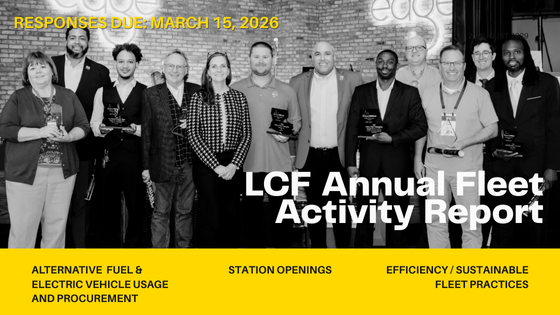
Louisiana Clean Fuels gathers data from stakeholders each year to compile a coalition report. This report showcases the impactful efforts within the LCF territory, serving as a tool to promote our coalition and region. It also creates avenues for securing funding for sustainable transportation projects. Additionally, our data drives the selection of awardees at our Annual Clean Fuel Leader Awards which will be held in the fall of 2026.
Who Should Participate In This Report?
At Any Time In 2025 - We Are Interested In Knowing If Your Louisiana Based Business...
- Purchased or operated vehicles fueled by Propane, CNG, LNG, Electricity, Hydrogen, or any hybrid vehicles.
- Utilized Biodiesel, Renewable Diesel, Renewable Natural Gas, or other renewable alternative fuels.
- Initiated or continued an idle reduction program.
- Implemented aerodynamics or added other fuel saving technologies on your vehicles.
- Optimized routes to conserve fuel or hosted driver training to optimize vehicle performance
- Upgraded older vehicles to smaller or more fuel-efficient models.
- For fuel providers/station owners: Constructed or managed Electric Vehicle charging or alternative fuel stations (CNG, Propane, bio-diesel, or LNG).
- For dealerships: Sold Plug-in Electric vehicles (Hybrid or BEV), Natural Gas, or Propane vehicles within LCF territory during 2024.
Your participation in this report could lead to recognition at our Annual Clean Fuel Leader Awards. Contact Tyler Herrmann at (504-858-1706) or email him at [email protected] for any inquiries or assistance submitting your data to LCF.
Annual reports are due by March 15, 2026. This is your chance to showcase your fleet's efforts in promoting sustainability and efficiency.

Industry News
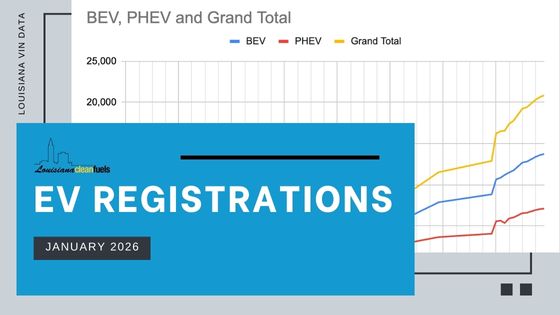
Louisiana’s EV market continued its steady climb in January 2026, surpassing 21,000 registered electric vehicles statewide, and the latest parish-level data show that growth is becoming both more consistent and more geographically concentrated.
Metro Areas Continue To Drive Adoption
The state’s largest and most urban parishes remain the engines of EV growth: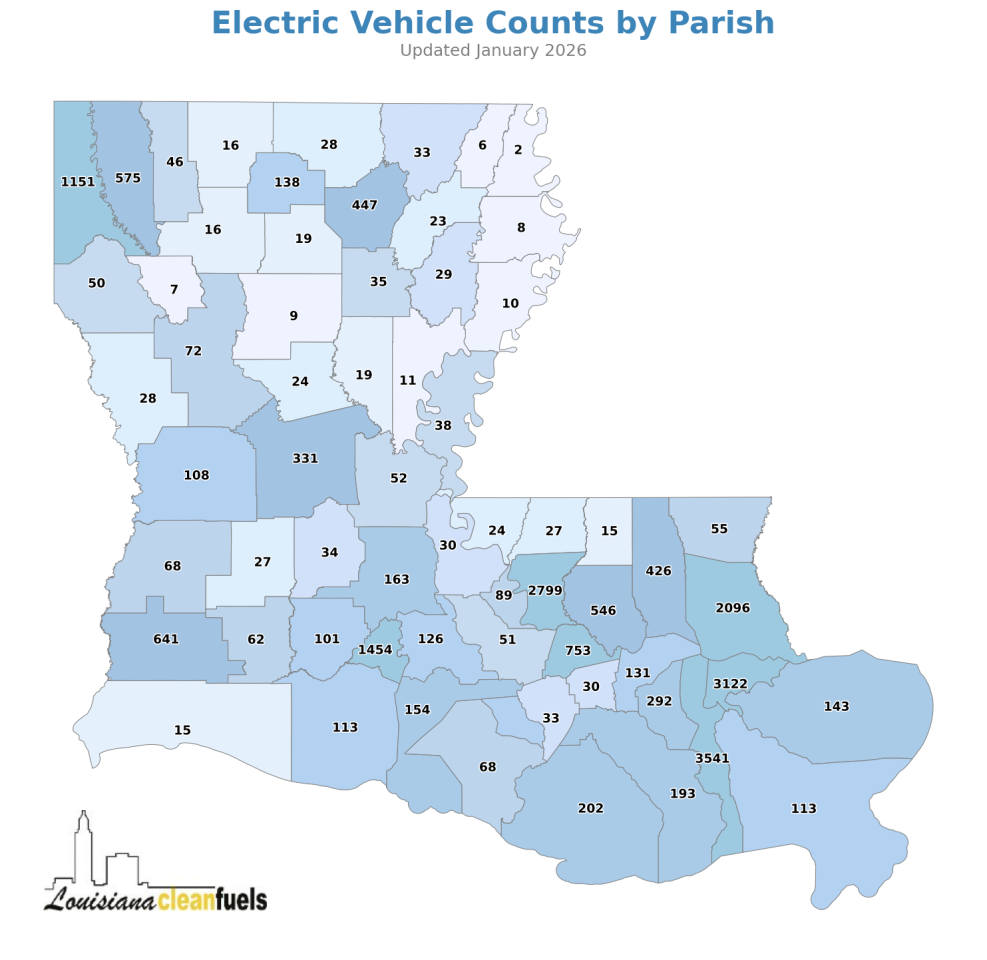
- Jefferson Parish now leads the state with 3,541 EVs, reflecting its large population base, higher household incomes, strong dealer presence, and proximity to New Orleans’ charging infrastructure.
- Orleans Parish continues to stand out with the highest EV penetration rate (1.38% of all registered vehicles) and one of the fastest growth rates in the state.
- East Baton Rouge Parish added EVs steadily through 2025 and into January 2026, reaching nearly 2,800 registered EVs, reinforcing its role as a statewide adoption anchor.
Together, these parishes illustrate a clear pattern: higher population density, shorter daily trip lengths, and better access to charging correlate strongly with higher EV adoption.
Studies and Demonstrations
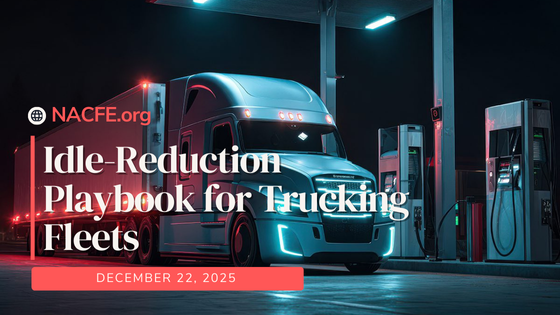
via NACFE.org | Published December 2025
The Idle-Reduction Playbook: Operational Strategies For Modern Trucking Fleets
NACFE has released a new report on idle reduction, The Idle-Reduction Playbook: Operational Strategies for Modern Trucking Fleets. This is the second update to the initial idle reduction Confidence Report published by NACFE in 2014. The report looks at the reasons trucks idle and provides insight into a variety of idle-reduction technologies that are currently available. It also includes best practices and recommendations for managing idle time
Both the economic and environmental stakes of idling are high. At an average diesel price of $4 per gallon, a single long-haul truck might waste $4,000 to $6,000 worth of fuel each year if it idles overnight. For fleet operators, the challenge lies in finding practical ways to reduce idle time without compromising driver comfort, safety, or operational efficiency. any idle reduction strategy must provide an alternative heating, cooling, and auxiliary power source.
Resources
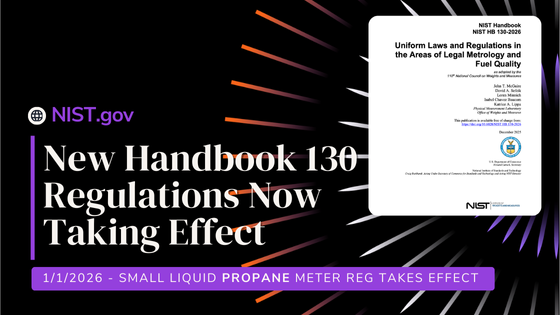
New Handbook 130 Regulations Now Taking Effect: What Propane Stakeholders Need to Know
New national measurement standards for the propane industry are now moving from policy to practice. While updates to NIST Handbook 130 were finalized in 2024, the compliance timeline is officially underway, with significant requirements taking effect over the next several years.
The updated regulations focus on Automatic Temperature Compensation (ATC) for liquid propane meters. ATC adjusts propane volume to a standard temperature of 60°F, ensuring consistent and accurate measurement regardless of seasonal or ambient temperature conditions.
Key compliance milestones include:
-
January 1, 2026: All newly installed small liquid propane meters (less than 20 gallons per minute) must be equipped with ATC.
-
January 1, 2030: All liquid propane meters in service—existing and new—must include ATC. There is no grandfathering for older equipment.
These changes are intended to improve accuracy, transparency, and consumer confidence in propane transactions while creating uniform measurement standards nationwide. For propane retailers, fleet operators, and equipment owners, early planning will be critical. Reviewing existing metering equipment, understanding upgrade options, and coordinating with vendors and state weights and measures officials can help avoid compliance challenges as deadlines approach.
Louisiana Clean Fuels will continue monitoring how these national standards intersect with state implementation and enforcement and will share updates and technical resources as they become available.
Resources & Further Reading
-
NIST Handbook 130 – Uniform Laws and Regulations in the Areas of Legal Metrology and Engine Fuel Quality
https://www.nist.gov/pml/owm/publications/nist-handbooks/handbook-130 -
BP News: How New Handbook 130 Regulations Will Transform the Propane Industry
https://bpnews.com/equipment/how-new-handbook-130-regulations-will-transform-propane-industry -
LP Gas Magazine: Changes Coming to Temperature Compensation Requirements
https://www.lpgasmagazine.com/changes-coming-to-temperature-compensation-requirements/
About LCF
Louisiana Clean Fuels is a designated coalition in the US Department of Energy's Clean Cities and Communities partnership, supported by the Louisiana Department of Concervation and Energy and member organizations. We are a 501(c)(3) non-profit organization serving fleets for 25 years.
The mission of Louisiana Clean Fuels, Inc. is to advance the nation’s environmental, economic, and energy security by supporting local actions to reduce emissions and diversify transportation fuel options. Our goal is to show how advanced technologies and alternative fuels can help meet business and environmental goals. By providing objective data, technical resources, and the right connections, we help fleets find reliable solutions that will stabilize or lower fuel costs.
